THE CRUISE SHIP, THE VIRUS, AND THE GLOBAL WAKE-UP CALL
On April 1, 2026, a Dutch expedition cruise ship called the MV Hondius left Ushuaia, Argentina — the southernmost city in the world — bound for Antarctica and several remote South Atlantic islands. By the time the world was paying attention, three people were dead, eight cases of hantavirus had been confirmed or suspected, and contact tracers across six continents were scrambling to find passengers who had quietly dispersed to their home countries weeks earlier.
Thank you for reading this post, don't forget to subscribe!This is the story of how a birdwatching trip became a global health emergency — and what it tells us about why health awareness cannot wait for a crisis to make the headlines.
HOW IT STARTED: THE BIRDWATCHERS AND THE VIRUS
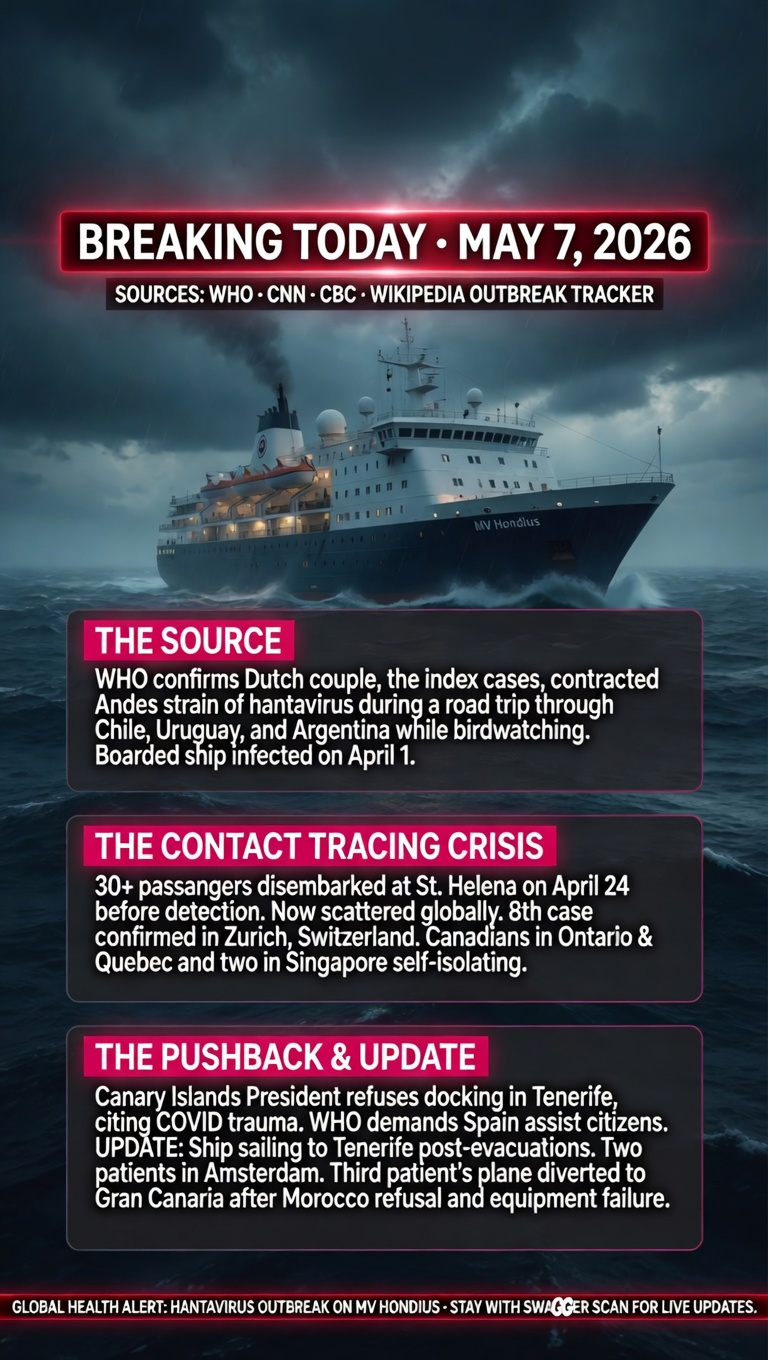
The World Health Organization now believes the outbreak began before the ship even left port. A Dutch couple — later identified as the index cases — had spent four months travelling through Chile, Uruguay, and Argentina before joining the cruise. During that trip, they visited areas where the Andes strain of hantavirus is known to circulate in local rodent populations.
Hantavirus is primarily transmitted through contact with infected rodent urine, feces, or saliva. You don’t need to be bitten. Simple exposure to contaminated material — touching a surface, breathing in dried particles — is enough. The Andes strain, found predominantly in South America, is the only known hantavirus capable of human-to-human transmission, though this remains extremely rare and is typically limited to people in very close prolonged contact. The Dutch couple boarded the Hondius on April 1 and it is said that they were likely already infected.
THE OUTBREAK UNFOLDS
The first passenger — a 70-year-old Dutch man — fell ill on board with fever, headache, abdominal pain, and diarrhea. He died on April 11. His wife, who had also been infected, disembarked at St. Helena — a British overseas territory in the South Atlantic — on April 24, already showing gastrointestinal symptoms. She deteriorated during her flight to Johannesburg, South Africa, and died upon arrival at the emergency department on April 26.
A British passenger fell ill on April 27 and was evacuated from Ascension Island to South Africa, where he is now recovering in intensive care. A German woman with pneumonia died on board on May 2. A Swiss man sought medical attention on his own initiative after returning home and tested positive in Zurich. Two Singaporeans are self-isolating. Three Canadians are being monitored after returning home.
As of May 7, 2026: 8 cases confirmed or suspected. 3 deaths. 23 nationalities on board. Contact tracing operations underway across multiple countries and continents.
THE CONTACT TRACING CRISIS
Perhaps the most alarming development in this story is not the cases on board — it’s the passengers who got off before anyone knew hantavirus was present. Over 30 passengers disembarked at St. Helena on April 24, including the wife of the first victim. Those passengers, from multiple countries, have since returned to their homes around the world.
The ship’s operator, Oceanwide Expeditions, acknowledged this only after reporting had already surfaced it — raising serious questions about the timeline of disclosure. Contact tracing for passengers on the flight carrying the Dutch woman has been initiated. Countries including Canada, Singapore, Switzerland, the Netherlands, South Africa, Spain, and the United Kingdom are all now involved in coordinated response measures.
THE POLITICAL STANDOFF
After days anchored off Praia, the capital of Cape Verde — which authorities determined was not equipped to handle the scale of evacuation needed — the ship was directed toward Tenerife in Spain’s Canary Islands. But the president of the Canary Islands, Fernando Clavijo, announced he “cannot allow” the ship to dock, citing the trauma of the COVID-19 pandemic and fears for the safety of island residents.
The WHO responded with unusual directness, stating that Spain has a “moral and legal obligation” to assist the passengers — several of whom are Spanish citizens. As of May 7, the ship is en route to Tenerife, with the situation still evolving.
WHAT THIS MEANS
The MV Hondius outbreak is, in many ways, a story about the gap between when health risks emerge and when people have the information to respond to them. The index cases were infected weeks before anyone knew. Passengers disembarked and scattered. A woman died on a flight between continents. A man sought testing on his own initiative in Switzerland and found he was positive.
In every one of those scenarios, earlier awareness could have changed the outcome. Not perfect information — but more of it. The habit of staying informed. The willingness to have the conversation before the crisis forces it.
That is precisely what swaGGerscan was built to normalize — not fear, but awareness. Not surveillance, but knowledge. The understanding that in a connected world, health is never fully a private matter. It is always, in some measure, a shared one.
swaGGerscan published Hantavirus education content before the MV Hondius story broke globally. Because health conversations cannot wait for the headline.